

A memorable hotel meal begins long before a guest sits down at the table. Behind every plate are decisions about where ingredients come from, who produces them, how they are transported, how they are handled and how they reach the kitchen.
For hotels, lodges, restaurants and resorts across Africa, these decisions present an opportunity to do more than deliver quality dining experiences. Thoughtful local sourcing can connect hospitality businesses with farmers, food producers, local enterprises and cultural traditions while creating opportunities for stronger, more resilient supply chains.
But buying locally is not automatically sustainable, and not every local purchasing arrangement benefits the wider community equally. The real opportunity lies in building responsible sourcing systems that balance quality, food safety, fair commercial relationships, environmental considerations and local economic value.
From farm to guest plate, every purchasing decision can help shape the future of hospitality.
Why local sourcing matters in African hospitality
Tourism creates demand for a wide range of goods and services, including fresh produce, meat, fish, dairy products, beverages, spices and traditional food products.
When hospitality businesses connect this demand with capable local producers, they can create opportunities for agricultural enterprises and strengthen links between tourism and the wider economy.
The Global Sustainable Tourism Council (GSTC) recognizes local purchasing as an important element of sustainable tourism. Its Hotel Standard includes responsible sourcing, prioritizing local and fair-trade suppliers where appropriate, and measuring the proportion of goods and services purchased from locally owned and operated businesses. Source: GSTC Hotel Standard.
The significance of this approach extends beyond procurement. Local sourcing can influence the guest experience, the visibility of regional food culture, business relationships and the distribution of tourism-related economic opportunities.
However, the outcomes depend on how sourcing is organized. A hotel may purchase from a distributor based in the destination while the food itself comes from another country. Although the purchase supports a local intermediary, it may create fewer direct opportunities for local producers than a well-designed relationship with regional farmers.
The important question is therefore not simply, “Do we buy locally?”
It is: Where does the food come from, who benefits from the transaction, and how responsibly is it produced and supplied?
1. From farm to kitchen: Understanding the local food supply chain
A local food supply chain connects producers with the businesses and consumers who purchase their products. In hospitality, that journey may involve farmers, cooperatives, aggregators, distributors, transporters, food processors, wholesalers and hotel purchasing teams.
Each participant plays a role in getting food to the guest plate.
Consider a lodge that serves fresh vegetables at breakfast and dinner. Its ingredients may come from nearby smallholder farmers, a farmers’ cooperative, a regional wholesaler or a combination of these sources.
The sourcing arrangement influences several operational factors, including delivery reliability, freshness, product quality, cost, traceability and the ability to respond to changing demand.
A well-managed supply chain begins with understanding what the kitchen needs and what local suppliers can realistically provide.
Hospitality businesses can start by:
- Mapping their main food and beverage suppliers.
- Identifying which ingredients are produced locally or regionally.
- Understanding seasonal availability and production capacity.
- Establishing quality, storage, delivery and food-safety requirements.
- Reviewing payment terms and ordering practices.
- Identifying opportunities to work directly with producers or through effective cooperatives and aggregators.
Local sourcing does not require every ingredient to come from the immediate surroundings. Some destinations may lack the climate, production capacity, infrastructure or specialist suppliers needed for particular products.
A practical approach prioritizes local and regional options where they meet operational needs, while sourcing other products responsibly from elsewhere.
The objective is to develop a supply chain that is reliable, transparent and appropriate to the destination.

2. Supporting local producers and strengthening local economic value
One of the key opportunities presented by local sourcing is its potential to connect tourism expenditure with local enterprises.
Hotels and restaurants purchase food regularly. When some of that demand is met by capable local producers, it can create opportunities for farmers, fishers, food processors and other businesses.
However, market access alone is not enough. Producers may also need reliable transport, suitable storage, consistent demand, working capital and predictable payment arrangements to meet hospitality requirements.
Research on tourism supply chains in Africa illustrates the importance of connecting local producers with the requirements of tourism businesses. A 2025 study published in the African Journal of Hospitality, Tourism and Leisure examined the potential for community farmers to supply fresh produce to luxury wildlife tourism lodges, highlighting the importance of aligning producer capacity with hospitality demand.
This points to a practical lesson: local sourcing works best when buyers and suppliers understand each other’s needs.
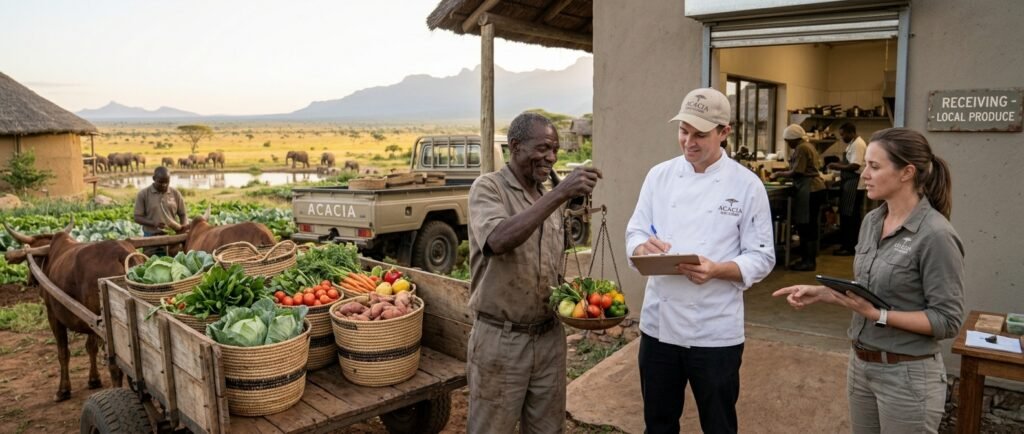
Hotels can strengthen these relationships by:
- Sharing purchasing forecasts and anticipated demand.
- Establishing fair and transparent commercial terms.
- Paying suppliers according to agreed schedules.
- Planning menus around suitable seasonal products.
- Supporting supplier development where appropriate.
- Working with cooperatives or aggregators when they help smaller producers meet requirements.
Local sourcing should not be treated as charity. It is a commercial relationship in which both parties need to create value.
When suppliers can meet requirements and businesses maintain dependable purchasing relationships, local procurement can contribute to stronger economic connections between tourism and other sectors.
3. Celebrating African food culture through the guest experience
Food is an expression of place. Ingredients, preparation methods, recipes and eating traditions can communicate a destination’s history, environment and cultural identity.
For hotels and lodges, locally informed menus can help guests experience more than accommodation and scenery. They can introduce visitors to regional dishes, seasonal ingredients and culinary traditions that make a destination distinctive.
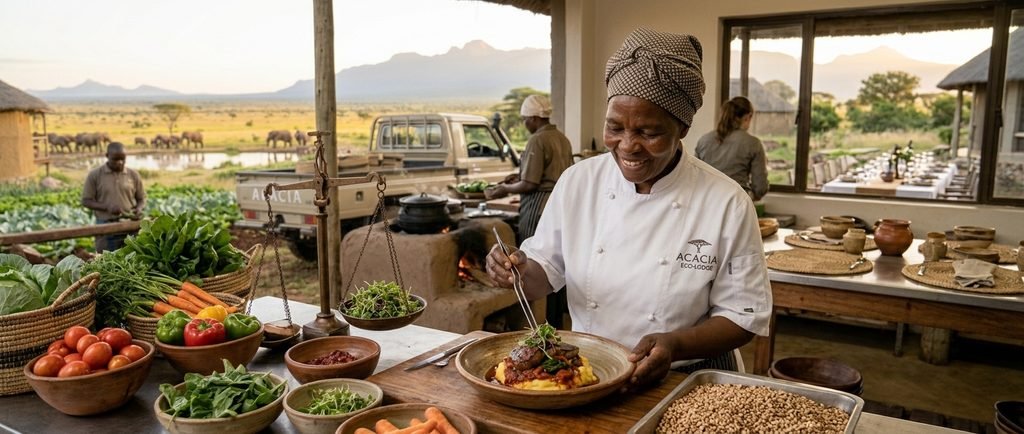
Hospitality businesses can incorporate food culture by:
- Featuring regional dishes alongside familiar menu options.
- Working with local cooks and culinary specialists.
- Highlighting seasonal ingredients and their origins.
- Sharing accurate stories about producers and food traditions.
- Organizing tastings or cooking experiences with community partners.
- Ensuring that contributors are acknowledged and fairly compensated.
Authenticity matters. Local cuisine should not become a marketing decoration or be presented through inaccurate cultural stories.
Hotels should consult the people connected to the food traditions they feature, represent those traditions respectfully and obtain appropriate permissions when using personal stories or community cultural knowledge.
Done thoughtfully, food can become a meaningful part of the guest experience while creating opportunities for local culinary businesses.
4. Freshness, quality and food safety come first
Local sourcing can provide access to seasonal ingredients and shorter distribution routes. Depending on the product and supply chain, this may reduce the time between harvesting and preparation.
However, proximity alone does not guarantee freshness or quality. Harvesting practices, storage conditions, temperature control, transport and handling all affect the condition of food when it reaches the kitchen.
Food safety must remain non-negotiable.
Hotels should establish clear supplier approval procedures, appropriate storage and handling controls, traceability records where required, and checks for incoming deliveries.
They should also communicate product specifications and delivery expectations clearly to suppliers.
Where producers need support to meet these requirements, hospitality businesses can provide practical guidance on packaging, documentation, handling and scheduling without compromising safety standards.
The Food and Agriculture Organization of the United Nations has discussed both the opportunities and challenges associated with local food sourcing for hotels, restaurants and catering businesses. Its work highlights the need to consider supplier capacity and the realities of procurement rather than assuming that local sourcing is automatically straightforward.
For hospitality businesses, the best sourcing arrangement is one that meets quality and safety requirements while creating appropriate opportunities for local suppliers.
5. Is local sourcing always more sustainable?
Local sourcing is often associated with sustainability, but environmental impacts depend on the entire supply chain.
Transport distance is one factor in a product’s environmental footprint. Production methods, fertilizer use, land management, water requirements, refrigeration, packaging, processing and food waste can also be significant.
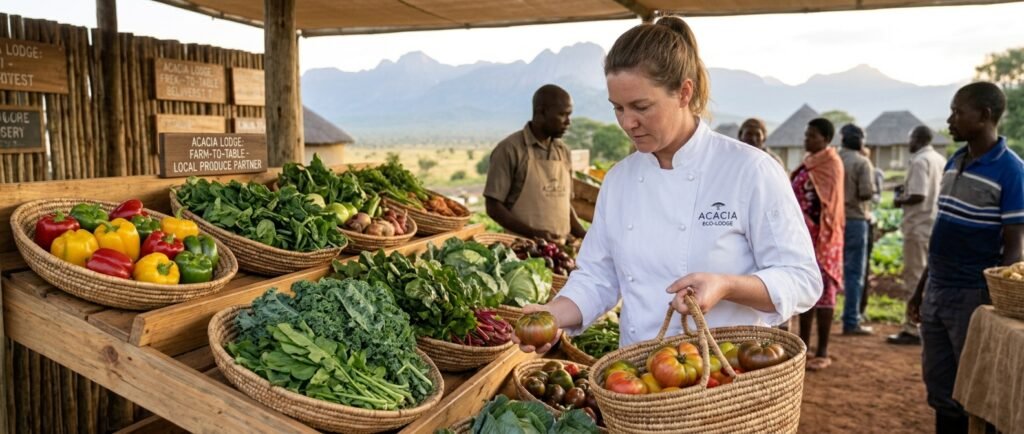
A locally produced ingredient is therefore not automatically lower-carbon than an imported alternative. Its overall impact depends on how it is produced, handled and delivered.
Hospitality businesses should consider the full context rather than rely on distance alone.
Practical actions include:
- Prioritizing suitable seasonal products.
- Asking suppliers about relevant production practices.
- Reducing unnecessary packaging where food safety allows.
- Improving delivery planning and purchasing efficiency.
- Selecting seafood and other products with attention to sustainability and traceability.
- Reducing food waste through better forecasting and menu planning.
- Considering credible environmental evidence when comparing alternatives.
Local sourcing may also diversify supply options, but local production can itself be affected by drought, floods, pests and seasonal shortages.
A resilient procurement approach combines local sourcing where appropriate with supplier diversification, risk assessment and responsible purchasing standards.
The goal is not to label every local product sustainable. It is to make better-informed decisions based on evidence.
6. Building stronger and more resilient food supply chains
Reliable food supply is essential to hospitality operations. Disruptions caused by extreme weather, transport problems, price changes or shortages can affect menu availability, service quality and operating costs.
Working with local producers may provide additional supply options, but resilience requires more than proximity.
Hotels need to understand their dependencies, assess supplier reliability and plan for periods when particular ingredients are unavailable.
Practical measures include:
Diversifying suppliers. Avoid relying entirely on one supplier for critical ingredients when suitable alternatives exist.
Planning for seasonality. Develop menus around realistic production cycles and communicate expected demand to suppliers.
Improving forecasting. Use occupancy levels, reservations, historical consumption and events to estimate purchasing needs.
Strengthening relationships. Maintain regular communication and establish clear expectations for quality, volume and delivery.
Preparing alternatives. Identify acceptable ingredient substitutions and alternative suppliers for essential products.
Monitoring performance. Review costs, delivery reliability, product quality and availability to identify emerging risks.
These actions can help businesses manage uncertainty while maintaining service standards.
They also demonstrate why local sourcing should be part of a broader procurement strategy rather than an isolated sustainability initiative.
7. Measuring progress: Turning local sourcing into action
A sourcing initiative becomes more useful when a business can establish a baseline and monitor progress over time.
Hotels can begin by reviewing purchasing records and identifying which suppliers, products and expenditure categories are local, regional or sourced from elsewhere.
The GSTC Hotel Standard provides a reference for measuring purchases from locally owned and operated businesses and considering environmental impacts in procurement decisions.
Hotels can track practical indicators such as:
| Indicator | What it measures |
|---|---|
| Local food procurement by value | Share of food expenditure spent on locally produced food |
| Number of local producers | Breadth of producer relationships |
| Supplier retention | Continuity of supplier relationships |
| Seasonal sourcing | Extent to which purchasing reflects seasonal availability |
| Delivery reliability | Consistency of supplier performance |
| Food waste per guest cover | Food waste relative to meals served |
| Supplier diversity | Dependence on individual suppliers or supply routes |

Hotels should define “local” clearly and distinguish locally produced goods from products merely distributed by a local business.
For example, a hotel could calculate the percentage of annual food expenditure spent on food produced within an agreed region. It could then monitor changes over time while maintaining food safety, quality, affordability and supply reliability.
These indicators are examples, not universal benchmarks. Each property should select measures appropriate to its operating context and establish targets based on its starting point.
8. How hospitality businesses can get started
Local sourcing does not require a complete redesign of a hotel’s procurement system from day one. A focused pilot can help identify opportunities, test supplier relationships and build internal confidence.
1. Review current purchasing. Identify major food categories, suppliers, expenditure and seasonal requirements.
2. Map local opportunities. Identify available products, potential producers, cooperatives and distributors.
3. Assess readiness. Review supplier capacity, quality, food safety, delivery schedules, pricing and traceability.
4. Select a manageable pilot. Start with a suitable product category, such as seasonal vegetables, fruit or herbs.
5. Agree on clear terms. Establish specifications, quantities, delivery schedules, pricing and payment arrangements.
6. Measure performance. Track costs, quality, delivery reliability, local procurement expenditure and food waste.
7. Learn and improve. Review the results with kitchen staff and suppliers before expanding the initiative.
The purpose of a pilot is to learn what works under real operating conditions. Progress should be based on evidence rather than assumptions that local sourcing will always be cheaper, fresher or more sustainable.
Conclusion: More than a meal
The journey from farm to guest plate reveals how closely hospitality is connected to the wider destination.
Purchasing decisions can influence opportunities for local producers, the visibility of regional food culture, the reliability of supply chains and the environmental impacts associated with food production and consumption.
But local sourcing delivers meaningful value only when it is implemented thoughtfully. Fair commercial relationships, food safety, reliable supply, responsible production and transparent measurement are essential to turning good intentions into practical results.
For African hospitality businesses, the opportunity is to move beyond simply buying local and build sourcing systems that connect business performance with stronger local economic relationships and more resilient destinations.
At OJIS Travels & Advisory, we believe sustainable tourism is shaped by everyday decisions—including what businesses buy, whom they work with and how they create value within the destinations they serve.
Source thoughtfully. Strengthen local partnerships. Create lasting value.
Join the conversation: What is one practical improvement your hospitality business could make to strengthen its local sourcing practices?
African Perspective. Global Outlook. Local Impact.